Introduction
In the world of database management, the terms SQL and NoSQL have become synonymous with two opposing philosophies of data storage and access. SQL databases, often referred to as relational databases, use structured tables to store data and enforce relationships between entities. They’re designed around the principles of data normalization, integrity, and flexibility, giving developers the ability to represent complex relationships directly within the database schema.
On the other hand, NoSQL databases like MongoDB, Couchbase, and Cassandra offer a more flexible, schema-less model, allowing data to be stored in various formats like documents, key-value pairs, or graphs. This structure is optimized for scalability, enabling NoSQL databases to handle massive amounts of data with ease, and to prioritize performance in distributed, high-read scenarios.
Common Misconceptions: It’s More than Relational vs. Non-relational
The SQL vs. NoSQL debate is often simplified as a distinction between “relational” and “non-relational” data, suggesting that only SQL databases are suited for applications with interconnected data, while NoSQL is for use cases with simpler, isolated data models. However, this is a misconception: relationships exist in nearly all real-world applications, regardless of database type. It’s rare for data to lack any relational structure; most data gains value from how it connects to other data. For instance, e-commerce applications involve users, products, and transactions that need to be interrelated. Social media platforms link users, posts, and interactions, and analytics systems frequently correlate metrics across multiple dimensions.
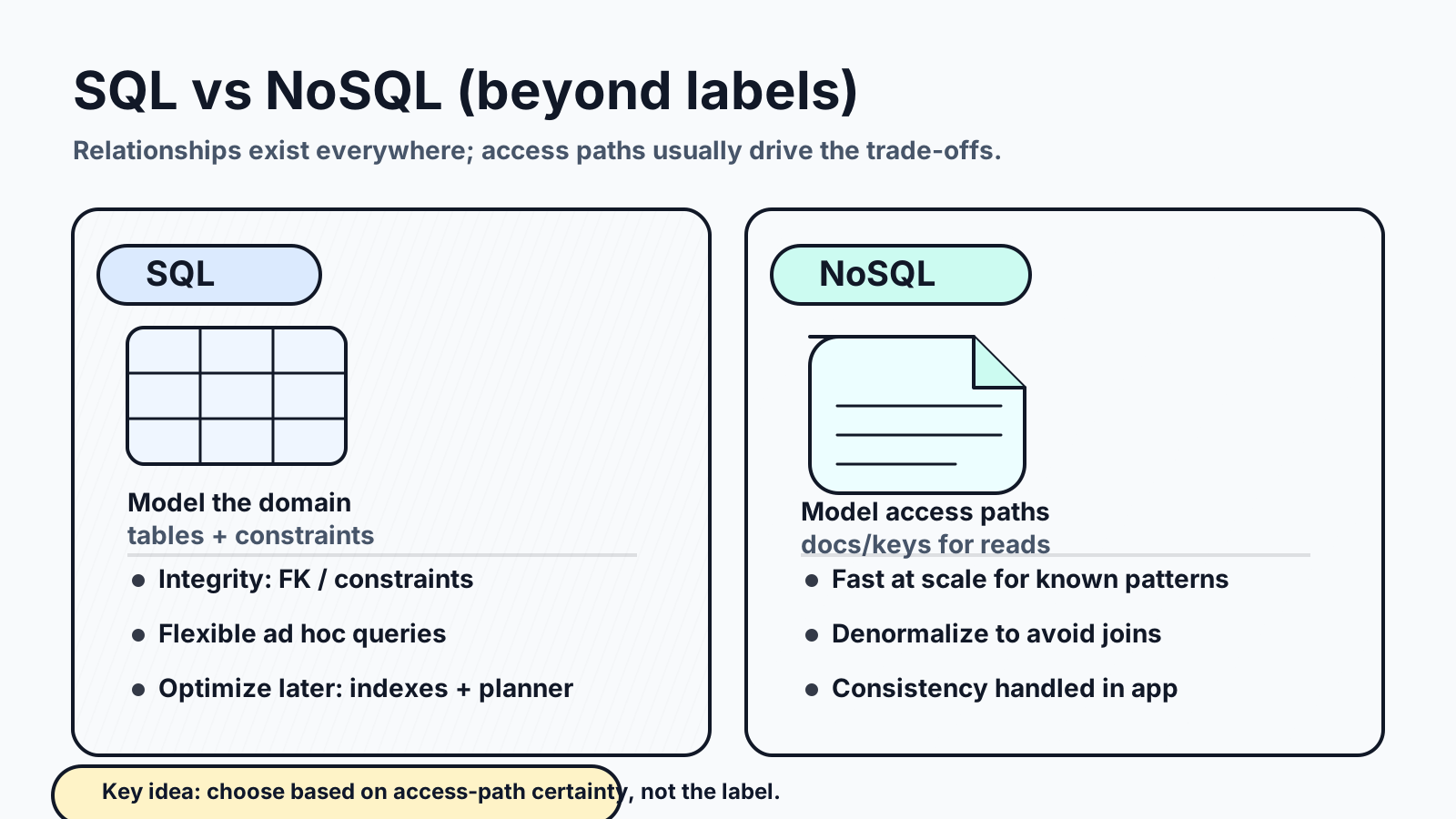
The real difference lies not in the presence or absence of relationships but in how each type of database expects you to handle those relationships. SQL databases natively enforce and model these relationships through joins, foreign keys, and constraints. NoSQL databases, however, often require you to manually handle relationships by structuring your data to reflect specific access paths—essentially designing the database around how you expect the data to be queried rather than how it’s naturally structured. This introduces a critical point: the focus on access paths and the upfront modeling decisions that come with it.
The Core Thesis: Access Paths as the Primary Differentiator
Understanding data relationships is critical, but even more crucial is recognizing how you need to access that data. In an SQL database, you can focus on modeling the domain naturally, letting the relational database handle access paths later with indexing, query optimization, and dynamic join execution. The goal is to ensure data integrity and flexibility, so that as new queries arise, the database can adapt without needing fundamental changes to the data structure.
Conversely, NoSQL databases are optimized for access patterns known in advance. They expect you to define how data will be accessed and queried from the outset, and then organize data accordingly, often at the cost of duplicating information across documents or collections. This design enables high-speed, low-latency access for reads but can lead to challenges if access patterns change over time, as updates or modifications require re-thinking the data layout.
The SQL vs. NoSQL decision is, therefore, not just about “relational” vs. “non-relational” but about predictability in access paths versus flexibility in data structure. This understanding becomes especially relevant as applications scale and evolve, with SQL databases offering adaptive querying power for unpredicted access patterns and NoSQL databases excelling in scenarios with predictable, stable query structures.
In this blog, we’ll delve deeper into how this core thesis influences the design, performance, and scalability of SQL and NoSQL systems. By understanding the nuances of access paths and relationships, you’ll be better equipped to select the right database for your application, based on your specific requirements and anticipated usage patterns.
The Nature of Data: Relationships are Fundamental
In nearly every real-world application, data exists in interconnected networks, where individual pieces gain meaning through their relationships to others. Even applications that seem to involve isolated data points ultimately require those data points to interact in significant ways. For example, an e-commerce platform deals with users, products, orders, and reviews. Each of these entities has its own set of attributes, yet they must be interrelated: users purchase products, orders contain products, and reviews are tied back to both users and products. It is this interconnected nature of data that necessitates relational thinking when designing data models, even if the database itself doesn’t explicitly enforce relational constraints.
Why Relationships Matter
When we say relationships are fundamental, we mean that the interconnectedness of data is essential to giving context and meaning. Consider a social media platform where users create posts and engage with one another through likes and comments. Each like or comment only has value in the context of its relationship with a specific user and post. Without these relationships, we’re left with isolated data that lacks functional or analytic depth. Furthermore, relationships are critical for ensuring data accuracy and maintaining consistency across various parts of the application, helping avoid scenarios where a product has reviews but no associated users, or where orders exist without matching products.
Relational structures allow applications to handle data consistently, which becomes crucial as the complexity of the application grows. When relationships are enforced, applications can rely on the database to maintain the integrity of these relationships, safeguarding against common errors and redundancies.
SQL’s Core Philosophy: Built for Relational Models and Data Integrity
SQL databases were fundamentally designed with relationships at their core. These relational databases use tables and schemas to enforce structured, normalized data, relying on principles like foreign keys, primary keys, and constraints to uphold referential integrity. This structure enables SQL databases to handle relationships naturally, allowing developers to rely on the database to enforce these rules and maintain consistency. Through joins, SQL databases allow data to be queried in relation to other data, meaning that complex, interlinked queries can be constructed without duplicating information across tables.
SQL databases adopt a normalized structure, which minimizes data redundancy by storing data in separate tables and establishing relationships between them. For example, in an e-commerce platform, instead of duplicating user information with every order, we can have a separate "Users" table and an "Orders" table, linked by a foreign key. This approach simplifies data updates—when a user’s information changes, it only needs to be updated in one place. SQL databases are optimized for handling these types of operations, where the relationships between data points are preserved without requiring complex data reorganization or manual joins.
By design, SQL databases prioritize consistency, atomicity, and integrity, making them a natural fit for applications with complex, evolving relational needs. This built-in relational model supports flexible querying and ensures that as new data relationships emerge, they can be integrated into the schema without disrupting existing structures.
NoSQL’s Flexible Schema: Relationships with Manual Effort
NoSQL databases, in contrast, are schema-less, meaning they don’t enforce a rigid table structure or relational constraints. This flexibility is one of NoSQL’s strongest advantages, particularly in applications where data structures are highly dynamic, or relationships are relatively shallow and well-defined at the outset. NoSQL databases use structures like documents (in MongoDB), key-value pairs (in Redis), or columns (in Cassandra) to store data, which can be adjusted as needed without altering a formal schema.
However, while NoSQL’s flexibility in data modeling is powerful, it lacks built-in relational enforcement. Without foreign keys or joins, developers must model and manage relationships manually if they need to represent interdependencies between data. For instance, in MongoDB, one approach to storing related data is to embed entire documents (such as a user document containing an array of order documents) within another document. This denormalized structure allows for rapid reads but can lead to data duplication, inconsistencies, and complexity in managing updates. If a user's information changes, it needs to be updated in every document where that information appears, a process known as data duplication.
In cases where data relationships are more complex or less predictable, developers may need to resort to techniques like manually referencing document IDs across collections and performing "join-like" operations in application code. This workaround is not only more cumbersome than SQL’s native join functionality but also places the responsibility for data consistency on the application layer rather than the database itself.
NoSQL databases are most effective when data relationships are simple, or when the access patterns are well-defined from the beginning, as they allow for optimized reads at scale without the complexity of relational enforcement. But as application requirements evolve, managing relationships in NoSQL can become challenging, especially if relationships become more intricate or if access paths need to be redefined. This often requires a careful upfront understanding of data access patterns to avoid the need for complex restructuring later.
In sum, relationships are inherent in most applications, regardless of the database used. SQL databases are designed to handle relationships with ease, enforcing data integrity through relational constraints and supporting flexible querying with minimal data duplication. NoSQL, while powerful in handling unstructured or semi-structured data, requires developers to adopt strategies to simulate relational integrity, which can be challenging and costly as applications scale. This fundamental difference in handling relationships marks a key divergence between SQL and NoSQL databases, influencing which is better suited to a particular application’s needs.
Data Access Path: The Key Difference
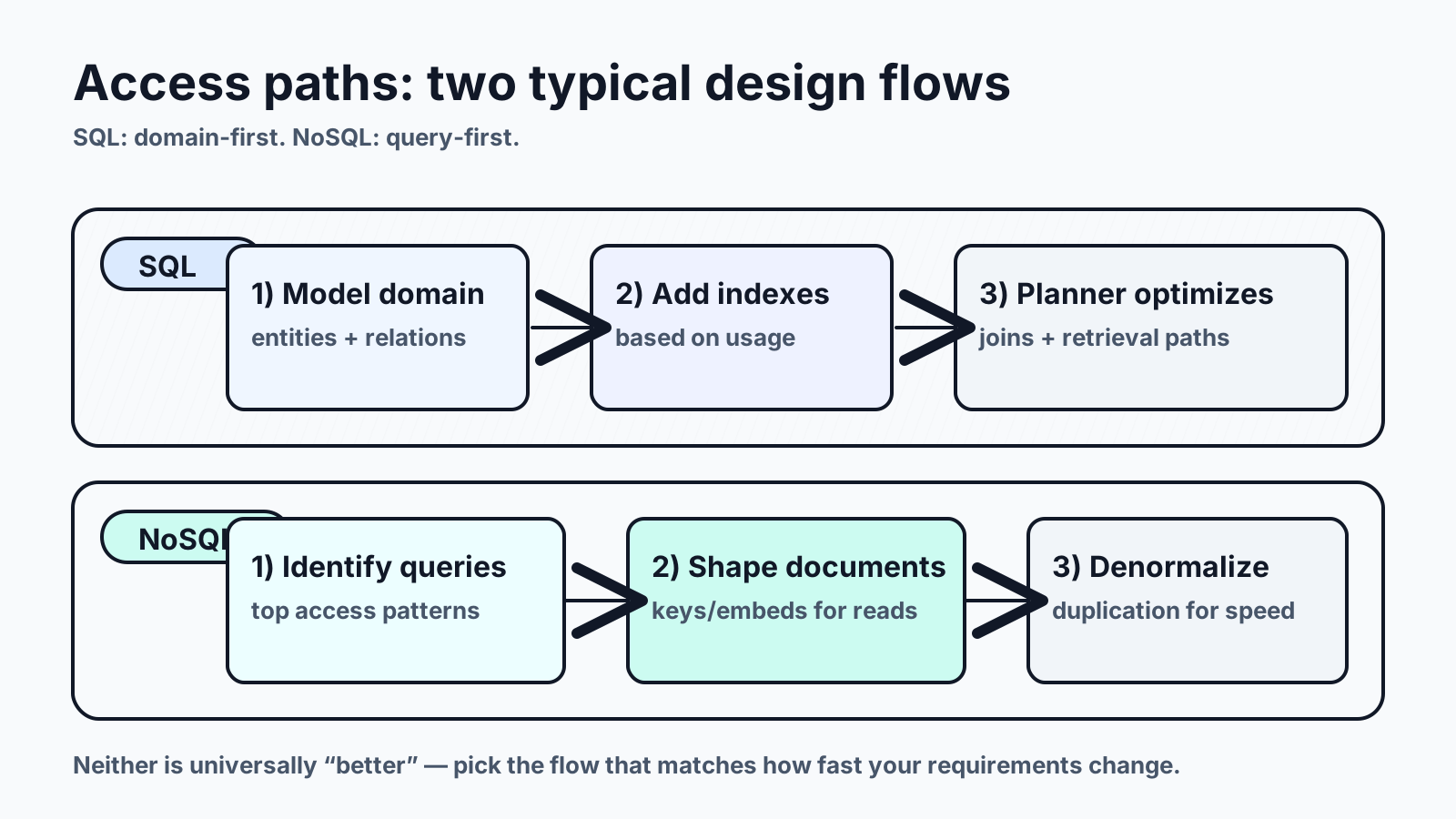
When evaluating SQL and NoSQL databases, one of the most significant differences lies in how each handles data access paths. Access paths—essentially, the routes and methods by which data is retrieved—determine a database’s performance, scalability, and flexibility under different workloads. SQL and NoSQL databases each approach access paths in distinct ways, driven by their respective design philosophies and underlying data structures.
Access Path in SQL: Flexibility Through Domain Modeling
In SQL databases, data modeling focuses on accurately representing the domain in a structured, relational format. Data is stored in normalized tables with relationships established through foreign keys, allowing developers to structure data logically according to its inherent connections. This approach enables SQL databases to handle complex queries and evolving access patterns flexibly, without requiring constant adjustments to the data model.
-
Domain Modeling First: SQL databases allow developers to focus on modeling the domain itself without needing to consider exact access paths upfront. Relationships and constraints are built into the schema, meaning that data can be stored in its most logical, normalized form without prematurely optimizing for specific queries. This approach also supports future-proofing, as changes to access patterns can be accommodated without fundamental restructuring of the data.
-
Deferred Optimization of Access Paths: Because SQL databases separate the relational model from access paths, query optimization can happen dynamically based on observed usage patterns rather than static assumptions. Once a schema is in place, developers can optimize queries and access paths as needed through indexing, partitioning, or caching, without disrupting the underlying data structure. This flexibility makes SQL databases ideal for applications with complex, unpredictable query needs or those that evolve over time.
-
Built-in Indexing and Query Optimizers: SQL databases leverage powerful built-in query optimizers and indexing options to handle access paths. The optimizer analyzes each query, determining the most efficient way to retrieve data based on factors like indexing, joins, and aggregation. This process is largely automated, with SQL engines adjusting access paths dynamically according to the workload. Indexes can be added to speed up frequent queries, and the database engine can optimize joins and aggregations, enabling flexible querying without compromising relational integrity.
This separation of domain modeling and access path optimization allows SQL databases to handle a broad range of applications with variable query patterns, providing a robust solution for applications where new access paths may emerge over time.
Access Path in NoSQL: Rigidity for Performance
In contrast, NoSQL databases are designed to perform exceptionally well in environments where access patterns are predictable and fixed. Here, the efficiency of data access comes from designing data structures that reflect the anticipated query paths, often requiring a trade-off between flexibility and performance.
-
Access Path as the Starting Point: In NoSQL databases, designing an efficient data model typically begins with understanding the access paths and query patterns. Instead of focusing on a normalized relational model, developers structure data to optimize for predefined queries, often denormalizing data to reduce the need for joins. This access-path-driven design means that data layout is tightly coupled with the way the application will query it, trading flexibility for fast, predictable reads.
-
Denormalization and Data Duplication: To avoid complex joins, NoSQL databases commonly rely on denormalization, where data is duplicated across documents or collections. For instance, in a document-oriented database like MongoDB, an order document might embed product details directly within the order rather than referencing a separate products collection. While this approach speeds up read operations by keeping all necessary data together, it can lead to challenges with data consistency and redundancy. If a product detail changes, every order containing that product must be updated, increasing the likelihood of inconsistencies and adding overhead to data maintenance.
-
Efficiency and Pitfalls of Fixed Access Paths: The performance gains of NoSQL databases come from their strict access-path design, which is ideal for applications where the query structure is predictable and stable. However, this approach introduces potential pitfalls if access patterns evolve. Changes in data access requirements may require substantial rework of the data model, as the denormalized structure lacks the flexibility of SQL’s relational model. Moreover, when an application’s query structure becomes more complex, simulating relationships and joins through application code can lead to increased maintenance and slower query performance.
NoSQL databases thus excel in use cases where high-speed access to large volumes of unstructured or semi-structured data is crucial, and the access patterns are well-known. However, they lack the inherent adaptability of SQL databases, requiring developers to anticipate future access paths during the initial modeling phase—a challenge when application requirements evolve.
In summary, the distinction between SQL and NoSQL in terms of access paths lies in their adaptability to change. SQL databases offer flexibility by separating domain modeling from access paths, enabling developers to refine and optimize access paths dynamically as the application grows. NoSQL databases, by contrast, achieve performance gains through fixed, denormalized access-path-driven designs, which, while efficient, limit adaptability to changing requirements. Understanding these differences is essential when choosing a database, as they influence how easily the database can scale and evolve alongside the application’s needs.
Modeling Complexity and Trade-offs
When it comes to handling complex data models, SQL and NoSQL databases take fundamentally different approaches, each with distinct strengths and trade-offs. SQL prioritizes data integrity, normalization, and schema enforcement, making it robust for applications where relationships between data are complex and the need for data consistency is paramount. NoSQL, on the other hand, emphasizes speed, scalability, and flexibility, excelling in cases where access paths are known in advance and hierarchical data structures are straightforward. However, both approaches come with challenges, especially as applications evolve and data models grow in complexity.
SQL’s Approach: Data Integrity and Flexibility
-
Data Integrity and Normalization: SQL databases are grounded in principles of data normalization, which means structuring data in a way that minimizes redundancy and maintains integrity through established relationships. Each piece of data is stored once, reducing duplication and ensuring that changes to any entity (such as a customer’s information) only need to be made in one place. Referential integrity, enforced through foreign keys and constraints, ensures that data relationships remain consistent, even as the data grows in complexity. This makes SQL ideal for applications that require high levels of data accuracy, such as financial systems or complex e-commerce platforms where data consistency is critical.
-
Flexibility for Unforeseen Queries: SQL databases are inherently flexible when it comes to querying, allowing developers to execute ad hoc queries on the fly without re-architecting the underlying data. This flexibility is crucial for applications that may need to perform complex analysis or support dynamic, unpredictable query patterns. SQL’s relational structure makes it possible to join tables and filter data in many ways without modifying the schema, enabling users to extract new insights as needs evolve. For example, in a retail application, if a new report requires linking sales data with customer demographics, SQL databases can easily support this query without restructuring data.
-
Challenges of Complex or Dynamic Schemas: While SQL databases excel at managing relationships and ensuring consistency, they can become cumbersome in applications with highly dynamic schemas or hierarchical data. For instance, if a schema frequently changes or if data is deeply nested (like in a social network with multiple levels of comments or replies), modeling these in a normalized SQL structure can become complex and may impact performance. The rigid structure of SQL databases can make frequent schema alterations challenging, often requiring significant planning and migration efforts, especially in large databases with complex relationships.
NoSQL’s Approach: Speed and Scalability
-
Prioritizing Speed and Scalability: NoSQL databases are built to handle high-throughput, distributed workloads where speed and scalability are the top priorities. By minimizing cross-document references and storing data in formats like key-value pairs or documents, NoSQL databases achieve fast read and write speeds. This makes NoSQL a natural fit for applications with well-defined, high-speed access patterns, such as content delivery networks or IoT applications that generate massive amounts of data requiring quick retrieval. In cases where scalability is crucial, NoSQL’s schema-less approach also allows for easier horizontal scaling, distributing data across multiple nodes in a cluster without the complexity of relational constraints.
-
Simpler Models for Document-Based or Hierarchical Data: NoSQL databases are often more straightforward for applications with simple, document-based, or hierarchical data structures. Document-oriented NoSQL databases like MongoDB allow developers to store complex data as single documents, embedding related information together. For example, an e-commerce order might contain the customer’s details, the ordered items, and shipping information in a single document, making retrieval fast and efficient. This structure eliminates the need for joins and reduces the overhead associated with normalized schemas, which can be beneficial in scenarios where hierarchical data is read frequently and the relationships between data entities are simple.
-
Challenges with Evolving Access Patterns: Despite these advantages, NoSQL databases face significant challenges when access patterns or application requirements change. Because NoSQL databases rely heavily on upfront data modeling, changing access paths often requires rethinking the data structure. For example, if an application originally designed for simple lookups later requires more complex, relational queries, NoSQL databases may struggle to support these without substantial restructuring. The denormalized nature of NoSQL can also lead to data inconsistencies if updates are not carefully managed. With duplicated data in multiple documents, a change to a single piece of information (such as a product description) can require updates across all documents that reference it, increasing the risk of inconsistency and introducing complexity to data maintenance.
In summary, SQL and NoSQL each bring unique strengths and trade-offs to data modeling. SQL’s focus on data integrity and normalized relationships makes it robust and flexible for applications where query patterns may be dynamic, but it can become challenging to manage in highly dynamic or deeply hierarchical models. NoSQL’s emphasis on speed and scalability suits applications with predictable access patterns and simple or hierarchical data structures, but it requires careful upfront modeling and can struggle with evolving requirements. Understanding these trade-offs is essential for selecting the right database for any application, ensuring that it can meet current needs while also adapting to future growth and complexity.
Real-world Scenarios: Choosing SQL or NoSQL Based on Access Paths
To better understand the strengths of SQL and NoSQL databases, it’s helpful to examine real-world scenarios where access paths dictate the choice of one over the other. Here, we’ll look at two common use cases—e-commerce platforms and applications with hierarchical data like comments and reviews. Each scenario highlights the trade-offs in using SQL or NoSQL and illustrates how access patterns and data relationships play a crucial role in selecting the right database.
E-commerce Platform: Products, Users, and Transactions
E-commerce platforms typically involve multiple interconnected entities—products, users, transactions, and often reviews or inventory details. These elements are inherently relational, and the interdependencies require a robust, reliable way to manage connections and enforce consistency across entities.
-
Why SQL Works Well:
- Relational Integrity: In an e-commerce environment, transactions are tightly coupled with users and products. For instance, each transaction must reference a specific user and one or more products, potentially linking to inventory and price details. SQL databases manage this well by enforcing referential integrity through foreign keys and constraints, ensuring that every order or transaction points to an existing user and products. This built-in consistency reduces errors, such as a transaction without a valid user or an order with out-of-stock products.
- Complex, Evolving Query Needs: E-commerce platforms often require flexible querying to support a variety of use cases, from user order histories to sales reports and inventory tracking. SQL databases excel in handling such ad hoc queries without the need to restructure the underlying data. As new reporting or analytics needs emerge, SQL’s relational model allows developers to query data across tables efficiently, enabling deep insights without rearchitecting data models.
- Simplified Data Updates: In a relational structure, updating information, such as a product’s details or a user’s address, is straightforward. Each entity’s data is stored in a dedicated table, and updates only need to occur in one place. This minimizes data duplication and ensures consistent information across the platform, critical for maintaining up-to-date product listings, prices, and user data.
-
NoSQL’s Challenges:
- Handling Complex Relationships: While NoSQL databases like MongoDB allow for document embedding (e.g., storing product data within each order), this approach becomes complex when products are shared across multiple orders or when prices and availability change frequently. Duplicating product data within each transaction document can lead to inconsistencies and increases the effort needed to synchronize updates across multiple documents.
- Difficulties with Ad Hoc Queries: In a NoSQL database, supporting complex queries often requires creating specific indexes or restructuring data to optimize for different access patterns. This can be challenging as e-commerce needs evolve, requiring additional planning or costly migrations to accommodate new query requirements.
In summary, SQL databases tend to be a better fit for e-commerce platforms where data consistency, relational integrity, and flexible querying are crucial. The relational model supports the complex, interdependent relationships between users, products, and transactions while providing the flexibility needed to adapt to changing business requirements.
Hierarchical Data: Comments, Reviews, and Discussions
Hierarchical data, such as threaded comments, reviews with replies, or discussion threads, is common in social media platforms, forums, and content websites. This type of data is structured in parent-child relationships, where each comment may have multiple replies, forming a tree-like structure. Both SQL and NoSQL databases offer approaches for managing hierarchical data, each with distinct pros and cons.
-
SQL’s Approach:
- Maintaining Relationships: SQL can manage hierarchical data by using self-referencing relationships, where each comment or reply stores a reference to its parent comment. This approach allows for querying the entire thread by joining on these relationships, supporting structured, relational queries like “show all replies to a specific comment.”
- Challenges with Deep Hierarchies: SQL’s relational model can struggle with deeply nested hierarchies or large comment threads due to complex join operations that may impact performance as the hierarchy grows. While SQL can handle hierarchical data, it is often less performant when retrieving entire nested structures. Recursive queries or common table expressions (CTEs) can be used to retrieve hierarchical data in SQL, but they may introduce performance bottlenecks for deeply nested structures.
- Limited Flexibility for Nesting Levels: If the depth of nesting is unpredictable or frequently changing, SQL may require additional effort to manage this variability efficiently. Querying and updating deep hierarchies can require workarounds, making SQL less suited for applications with highly dynamic or deep nested structures.
-
NoSQL’s Approach:
- Efficient Retrieval with Document-based Models: Document-oriented NoSQL databases, like MongoDB, can represent hierarchical data directly by embedding child comments within parent comments in a single document. This approach makes retrieval fast and efficient, as an entire comment thread can be fetched in one read operation. For applications where users often view complete threads or discussions, this structure eliminates the need for joins, leading to lower latency.
- Challenges with Updating or Reorganizing Threads: While embedding makes retrieval efficient, it complicates updates. For instance, if a single comment needs to be updated or deleted, it requires modifying the entire document containing it. Additionally, if comments or threads need to be moved or reorganized, restructuring the document can be complex and may lead to inconsistencies if not managed carefully.
- Limited Scalability for Deeply Nested Structures: NoSQL’s document-based approach is efficient for moderate nesting but becomes challenging with very deep hierarchies. Document size limitations in NoSQL databases like MongoDB may restrict the depth or size of embedded hierarchies, necessitating alternative approaches (like separate collections) that reduce the performance advantage of document embedding.
In the case of hierarchical data, NoSQL databases can be highly effective when access patterns involve retrieving entire structures at once and when updates to individual elements are minimal. However, SQL may be preferable if each comment or review needs to be accessed or updated independently, or if the application requires extensive querying on individual components within the hierarchy.
In summary, the choice between SQL and NoSQL for real-world applications often comes down to the nature of the data relationships and access patterns. SQL’s structured, relational model supports complex interconnections and flexible querying, making it ideal for e-commerce platforms with intricate data dependencies. NoSQL’s document-oriented approach works well for hierarchical data that benefits from fast, bulk retrievals, but it can struggle with complex updates and deep nesting. By understanding the specific needs and access paths of each use case, developers can make informed decisions that maximize both performance and data integrity.
Balancing Relational Integrity and Scalability
One of the most significant challenges in selecting a database system is balancing the need for relational integrity with the demand for scalability, particularly as data grows and access patterns become more intensive. SQL and NoSQL each have unique techniques and tools to support this balance, but often, a hybrid approach (polyglot persistence) provides an effective solution, allowing applications to leverage the strengths of both systems.
Techniques for Maintaining Data Integrity in NoSQL
NoSQL databases prioritize speed and scalability, often by sacrificing strict relational integrity. However, many NoSQL systems implement techniques to provide data consistency in a way that supports large-scale, distributed systems.
-
Eventual Consistency: Eventual consistency is a model where data is not immediately consistent across all nodes in a distributed system. Instead, updates propagate gradually until all nodes reach the same state. This approach is common in NoSQL databases, particularly those optimized for read-heavy workloads. While it offers high availability and low latency, it comes with trade-offs in immediacy—applications need to tolerate brief periods of inconsistency. Eventual consistency works well for applications where slightly out-of-date information is acceptable, such as social media feeds or product catalogs.
-
Versioning: Some NoSQL databases use versioning to handle conflicts that arise from concurrent updates in a distributed environment. In this model, each update to a record generates a new version, allowing the application to resolve conflicts by choosing the most recent version or using other business logic. Versioning is particularly useful for systems where updates are frequent and distributed, as it helps manage consistency while maintaining a high level of availability.
-
Conflict Resolution: To manage data integrity, NoSQL databases may require custom conflict resolution strategies. For example, in Cassandra, “last write wins” is a common approach where the most recent update overwrites previous versions. Other databases may provide custom conflict resolution policies, allowing applications to handle conflicts based on business rules, such as merging changes or applying user-specific logic.
Scaling Relational Databases with Modern Tools
Despite the challenges of scaling SQL databases, modern tools and techniques make it possible to achieve high scalability while preserving relational integrity.
-
Sharding: Sharding is a method of horizontally partitioning data across multiple servers to distribute the load and improve scalability. Each shard holds a subset of the data, enabling the database to handle larger volumes of traffic and data. For example, an e-commerce application could shard its user base by region, with each shard containing data only for users in that region. This reduces the load on any single server while maintaining relational integrity within each shard.
-
Caching Layers: SQL databases can leverage caching layers, such as Redis or Memcached, to store frequently accessed data in memory. Caching reduces the need for repetitive database queries, thus decreasing latency and offloading demand from the primary database. This approach is particularly effective for read-heavy workloads, where data does not change frequently and can be cached without risking stale information.
-
Read Replicas: Many SQL databases support read replicas—copies of the primary database that handle read operations. By distributing read requests across replicas, SQL databases can improve performance and availability without compromising on data consistency. This approach is particularly useful for applications with high read-to-write ratios, where most operations can be served by read replicas without overloading the main database.
When to Consider a Hybrid Approach (Polyglot Persistence)

In some cases, a single database type may not satisfy an application’s varied data requirements. A hybrid approach, known as polyglot persistence, allows developers to use different databases for different parts of an application based on specific data needs and access patterns. For example:
- Transactional Data in SQL: Critical data that requires strict relational integrity, such as financial transactions or user profiles, can be stored in an SQL database to leverage its ACID (Atomicity, Consistency, Isolation, Durability) properties.
- Unstructured or Hierarchical Data in NoSQL: Data that benefits from rapid, scalable access, like product catalogs or user-generated content (e.g., comments or reviews), can be stored in a NoSQL database optimized for high-speed retrieval and flexible schemas.
Using a polyglot persistence approach allows each part of the application to benefit from the database technology that best suits its needs, achieving both relational integrity and scalability without sacrificing performance.
Conclusion
SQL and NoSQL databases are not strictly opposites but rather complementary tools that address different data modeling and access path requirements. SQL databases excel in scenarios where data relationships are complex and future queries are unpredictable, providing flexibility, relational integrity, and consistency that make them suitable for applications where evolving requirements are common. They allow for structured, normalized data models and support ad hoc analysis without rearchitecting the schema, making them ideal for use cases like e-commerce platforms, financial systems, and applications that require strong data consistency.
NoSQL databases, on the other hand, are designed for applications with stable, predictable access patterns and are highly optimized for speed and scalability. They provide a flexible, schema-less model that enables rapid development and effortless handling of unstructured or semi-structured data, making them well-suited for applications like content delivery networks, real-time analytics, and IoT systems. However, this flexibility comes with the trade-off of requiring a clear understanding of access paths upfront, as changes to data structures or relationships can be costly.
Ultimately, the choice between SQL and NoSQL is not about which is superior but rather which best fits the specific requirements of a given application. In some cases, a hybrid approach combining both SQL and NoSQL databases may offer the ideal solution, enabling applications to leverage the strengths of each to achieve both relational integrity and scalability. By understanding the nuances of each type of database and aligning them with the needs of the application, developers can make informed choices that enhance performance, data integrity, and scalability as applications grow and evolve.